
Executive Summary:
The Demographic Cliff: According to World Bank data, manufacturing powerhouses like Thailand will become "super- aged" societies by 2030. The multi-decade era of building industrial capacity on an endless supply of cheap manual labour has come to an end.
The Industrial AI Translation Gap: The primary barrier to regional automation is not capital expenditure, but a severe deficit in middle-management data analytics skills. The ASEAN Digital Integration Index (ADII) explicitly ranks "Digital Skills and Talent" as the region's worst-performing metric.
The Nordic Compliance Gateway: As global buyers enforce strict data sovereignty mandates, Nordic technology providers offer a critical "Trust Premium." Secure, neutral network architectures are essential for ASEAN exporters to maintain access to lucrative European and American markets.
The End of the Endless Labour Pool
For decades, the global supply chain has treated Southeast Asia as an infinite reservoir of affordable labour. That macroeconomic narrative has officially expired for the region's most advanced manufacturing
hubs. The World Bank data projects that by 2030, Thailand will transition to a "super-aged" society, while Singapore faces severe demographic contraction and Vietnam ages at an unprecedented rate. While younger, populous economies like Indonesia and the Philippines may temporarily absorb some manual labour overflow, mid-tier economies like Malaysia are already feeling the talent squeeze.
Replacing Hands with Steel
According to the International Federation of Robotics (IFR), while Asia accounts for an overwhelming 74% of new global industrial robot deployments, the motivation has rapidly shifted from purely increasing output to basic survival. There are not enough hands to keep the automotive assembly lines moving or the regional deep-sea ports operating. To stay competitive, these industrial corridors need to lead the fastest automation transition in modern economic history.
Beyond Robotics: The Shift to Networked Intelligence
The required transition extends far beyond purchasing robotic arms; it demands replacing human sensory input and intuitive problem-solving with networked intelligence. In vast manufacturing belts—from Thailand's Eastern Economic Corridor (EEC) to Vietnam's northern industrial zones—losing a veteran workforce means losing decades of operational intuition. Facilities must leapfrog directly to AI-driven predictive maintenance, private 5G networks, and interconnected smart logistics.
The Data Sovereignty Dilemma
However, as ASEAN factories digitise, a severe geoeconomic vulnerability regarding data sovereignty emerges. Highly subsidised Chinese automation hardware is flooding the region, often boasting initial Capital Expenditures (CAPEX) 30% to 40% lower than Western alternatives. Yet, recent international regulatory shifts view industrial data as a state-monitored asset. While Chinese vendors frequently counter this by promising local data servers within ASEAN, Western auditors are no longer satisfied with mere data residency. True compliance now requires absolute software lifecycle transparency and verifiable, backdoor-free network architectures. Consequently, a fully automated deep-sea port or regional EV factory running on compromised hardware risks alienating Western shipping companies and European importers.
For ASEAN manufacturers aiming to maintain high-margin export corridors to Europe and North America, initial hardware savings are quickly offset by the Total Cost of Ownership (TCO) resulting from compliance failures. This is where the Nordic industrial heritage transitions from a premium option to a mandatory compliance gateway. Finnish technology companies provide a secure, geopolitically neutral architecture:
KONE: Securing automated material flow in smart buildings and logistics centres.
Valmet: Integrating digitally automated processes for heavy industrial refining.
Nokia : Deploying private 5G enterprise networks for sovereign data control.
This Nordic Trust Premium ensures that Western insurers, logistics conglomerates, and global buyers maintain absolute confidence in the integrity of ASEAN supply chains.

Upgrading regional supply chains requires a fundamental shift from cheap manual labour to secure, 5G-enabled automation where data sovereignty is crucial.
The Friction Point: Stranded Assets and Skill Gaps
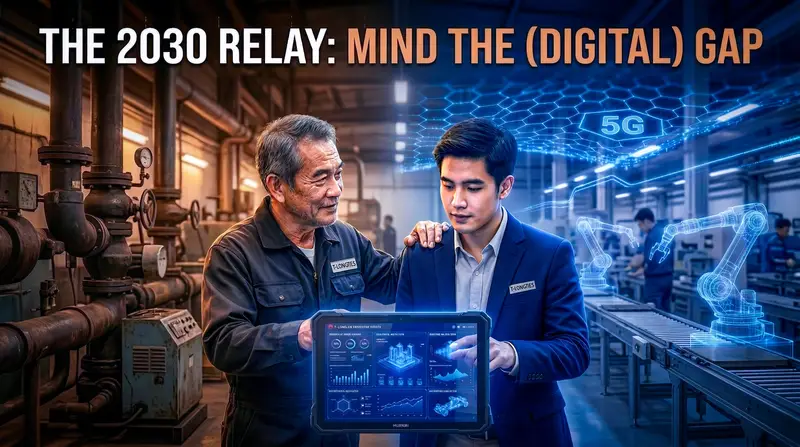
While top-tier conglomerates possess the capital for extensive automation upgrades, severe operational friction points remain. The ASEAN Digital Integration Index (ADII) explicitly ranks "Digital Skills and Talent" as the region's worst-performing metric. The bottleneck is not basic smartphone literacy, but the "Industrial AI Translation Gap." A manufacturing facility can deploy the world's most advanced automated systems, but if floor managers cannot translate physical production bottlenecks into data queries, the investment is paralysed. Furthermore, advanced autonomous guided vehicles (AGVs) cannot operate on legacy Wi-Fi networks that lack sufficient capacity, leaving expensive hardware stranded due to poor connectivity.
The technology for automation is ready and proven. The true bottleneck we see across industries today is the lack of automation skills and the organisational readiness required to deploy and manage these physical systems at scale. — Marc Segura, President, ABB Robotics Division
Strategic Imperatives for ASEAN Decision-Makers
Audit the Translation Gap: Before deploying capital in physical robotics, executives should assess and upskill the middle- management layer to ensure personnel can interpret enterprise- grade data analytics and STEM-related processes.
Deploy Sovereign' Nervous Systems': Prioritise installing private, enterprise-grade networks (such as Nokia's industrial 5G architectures) to guarantee the latency, reliability, and security required for heavy IoT deployments across vast facility footprints.
Treat Security as a Compliance Cost: When procuring automation ecosystems, decision-makers must factor in the vendor's long- term geopolitical risks. Prioritise data sovereignty and transparent software lifecycles to keep the facility compliant with EU and US supply chain data regulations.

The Automation Imperative. As working-age people in Thailand and Vietnam enter terminal decline, investments in industrial robotics must surge exponentially to prevent severe GDP contraction. Data modelled from World Bank, UNFPA, and IFR projections.
How are regional supply chains adapting middle-management training to bridge the Industrial AI Translation Gap? Share observations and strategies below.
Sources & Further Reading:
World Bank Group: Live Long and Prosper: Aging in East Asiaand Pacific (The definitive open-knowledge repository link for population ageing forecasts for Thailand, Vietnam, and Singapore).
ASEAN Secretariat:ASEAN Digital Integration Index Report 2.0 (The latest benchmark reporting on regional digital talent deficits and enterprise skill gaps).
International Federation of Robotics (IFR): World Robotics Report (Data regarding the 74% concentration of new global robot deployments in Asia).
ABB Robotics Insights: ABB Robotics Press & Executive Insights (Source of the Marc Segura quotation regarding organisational readiness and the physical automation skills bottleneck).
Nokia Enterprise Solutions: Industry 4.0 & Private Enterprise Networks (Research and case studies on private 5G deployment, Network-as-a-Service, and sovereign industrial architectures).
Written by Antti Rahikainen. Images assisted by AI.
#ASEAN #IndustrialAutomation #Industry40 #DataSovereignty #SupplyChainResilience #FutureOfWork #NordicTech