

Interview with Mohammad Zen, distinguished authority on halal certification
The clock is ticking for Finnish exports. A critical regulatory deadline looms, threatening to exclude Finnish food, pharmaceutical, and cosmetic companies from Indonesia, one of the world's most dynamic and lucrative consumer markets. The establishment of a national Halal Certification Centre in Finland is no longer a strategic choice, but an urgent economic necessity to safeguard existing trade and unlock vast future export potential, not only for Indonesia but also for the global Halal market.
Finland Faces a Non-Negotiable Deadline
Indonesia, the world's largest Muslim-majority nation, has mandated that all products entering and traded within its borders must be halal-certified. This rule for foreign-imported food and beverage products will take effect on 17 October 2026. After this date, any Finnish food product without a recognised halal certificate will be barred from the market. Enforcement will be strict and is not subject to negotiation.
Mohammad Zen, a former official at The Halal Product Assurance Organizing Body (BPJPH) and a key advisor to the Finnish initiative, underscores the gravity of the situation.
"The Indonesian government has postponed the original enforcement date from 2024 to 2026, but it won't do so again since many countries have their recognised halal certification bodies already. Countries that delay their preparations will be left behind."
This requirement extends beyond food, as pharmaceuticals, cosmetics, and medical devices face staggered deadlines between 2026 and 2036. For example, while Indonesia is not currently a major market for Finland's €1.2 billion (USD 1.3 billion) in global pharmaceutical exports, its rapidly growing healthcare sector, serving 270 million people, makes halal certification essential for accessing future opportunities.
A Global Market Awaits, With Indonesia at its Epicentre
The global halal market is valued at over €2.3 trillion (USD 2.5 trillion), with Indonesia at its centre. The domestic halal market is projected to nearly triple in size to almost €900 billion (USD 923 billion) by 2032. This impressive growth is further accelerated by the EU-Indonesia Comprehensive Economic Partnership Agreement (CEPA), finalised in September 2025 and expected to be ratified in 2027. It will lower tariffs and enhance the competitiveness of Finnish products.
Seizing this opportunity hinges on obtaining proper certification. A critical rule in Indonesia's system is the strict ban on cross-border certification. A certificate issued in another EU country, such as Germany or Spain, is invalid for products originating from Finland. The Halal Product Assurance Organizing Body, or Badan Penyelenggara Jaminan Produk Halal (BPJPH), is the Indonesian government agency responsible for regulating and issuing halal certifications, ensuring that products comply with stringent halal standards.
Mohammad Zen explains:
"BPJPH will only recognise halal certificates issued by an institution in the same country. Finland must establish its own halal authority to ensure its products are legally accepted in Indonesia. Without this, Finnish exports face significant risks."
Competitors are already advancing, with BPJPH having recognised 90 foreign halal institutions worldwide. In Europe, the recognised centres include Spain (5), Germany (4), France (3), the Netherlands (3), Belgium (2), Switzerland (1), and Belarus (1). This competitive disadvantage underscores the urgency for Finland to act swiftly.
The Blueprint for Success: Building a Credible and Profitable Centre
The LHLN process is well-defined and meets internationally recognised standards. LHLN stands for Lembaga Halal Luar Negeri, which translates to Foreign Halal Certification Body (FHCB). Supported by Dr Tuomo Rautakivi, an expert in Southeast Asian markets, and guided by the invaluable expertise of Mohammad Zen, the initiative has a clear roadmap for success.
To be effective, the Centre must be a legally established entity with a permanent organisational structure. Key requirements set by BPJPH include:
- A Shariah Board of at least three qualified Islamic scholars.
- A minimum of three certified halal auditors working exclusively for the institution.
- Accreditation from an internationally recognised body (such as the IAF MLA) and access to a laboratory accredited under ISO/IEC 17025.
The Halal Certification Centre must be legally established under either a government authority or a recognised Islamic organisation. Ultimately, Finland can decide which legal model best suits its national purposes and regulatory needs. The ideal approach recommended by Mohammad Zen is a hybrid partnership: an Islamic organisation supported by the Finnish government. This structure strategically combines religious credibility with operational efficiency, fostering compliance with both halal religious requirements and national legal frameworks.
Throughout the 6- to 8-month accreditation process, common challenges include ensuring laboratory readiness and meeting the requirements set by the Shariah Board. Laboratories must comply with ISO/IEC 17025 standards. Addressing these areas early on can help facilitate a smoother certification process.
Globally, halal certification centres are generally expected to operate as profitable, self-sustaining enterprises. Typically, revenue is generated through certification, audit, and renewal fees charged to companies seeking certification. This model ensures operational independence, maintains high standards, and reduces reliance on costly overseas certifiers. While the final business model for the Finnish Centre is still being determined, adopting such an approach could align well with international standards and market expectations.
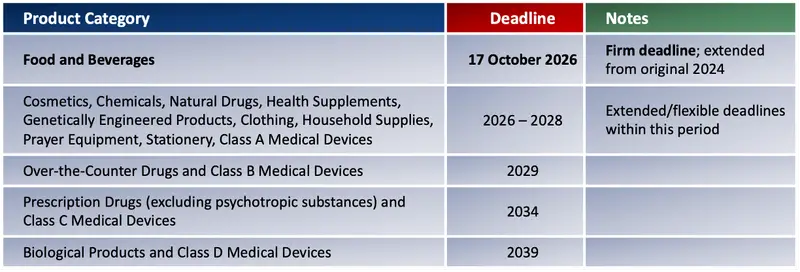
Halal certification deadlines for various product categories.
Beyond market access, a Finnish-issued halal certificate enhances brand reputation and trust across all Muslim-majority markets. As Mr Zen notes, passing Indonesia's strict standards is a global hallmark of quality that "automatically broadens the export market".
Meet the Key Experts Supporting the Initiative

Dr Tuomo Rautakivi and Mohammad Zen collaborate to advance the establishment of a Halal Certification Centres that meet international standards (right and left, respectively).
Mohammad Zen and Tuomo Rautakivi are providing assistance and guidance to another EU country and one ASEAN country that are interested in establishing Halal certification. They emphasise the importance of creating these centres to facilitate trade and ensure compliance with international standards. Their approach is supportive and collaborative, highlighting the need for Finland to develop its own Halal certification capabilities to meet global requirements.
Mohammad Zen, with his background at BPJPH, possesses a unique understanding of Indonesia's Halal requirements.
"I am personally involved... because I possess detailed knowledge of the accreditation requirements... This gives me a strong sense of responsibility to assist Finland in building its own halal body effectively, on time, and in line with Indonesian standards. Finland's reputation for transparency, high-quality food production, and advanced technology aligns very well with the values of the halal industry."
Dr Tuomo Rautakivi has extensive academic and governmental experience in specialising in regional business and organisational development, as well as governmental policies in Southeast Asia. Dr Tuomo Rautakivi adds:
"The establishment of this Centre is an absolute prerequisite for market access. For Finnish companies, the message is unequivocal: industry sectors must now join forces to establish a Halal Certification Centre that meets Indonesia's stringent requirements. The faster this happens, the better it will be for Finnish exports."
A Call to Action: The Time to Act is Now
The path forward is clear, but the window of opportunity is closing. Establishing the LHLN and gaining BPJPH recognition will take 6–8 months once the institution is fully prepared. Delay is no longer an option.
This initiative is a strategic investment in Finland's economic future. It will protect existing export revenues, enhance Finland's reputation for ethical and sustainable business practices, and open doors to one of the world's fastest-growing consumer markets. By integrating digital innovations such as AI and blockchain, the Centre can provide a competitive edge in terms of transparency and efficiency.
We urge Finnish businesses, industry bodies, and government authorities to collaborate and expedite the establishment of the Halal Certification Centre Finland. For inquiries, please contact Dr Tuomo Rautakivi.
Sources:
- Indonesian Law No. 33/2014 on Halal Product Assurance and official BPJPH documents.
- Cognitive Market Research, Halal Food Certification Market Report 2025.
- Data Bridge Market Research, Indonesia Halal Market Report 2024.
- EU & Indonesian Governments, Comprehensive Economic Partnership Agreement (CEPA), 2024.
- Interviews and direct contributions from Mohammad Zen, a former BPJPH official.
Written by Antti Rahikainen. Images created and edited with AI assistance.