
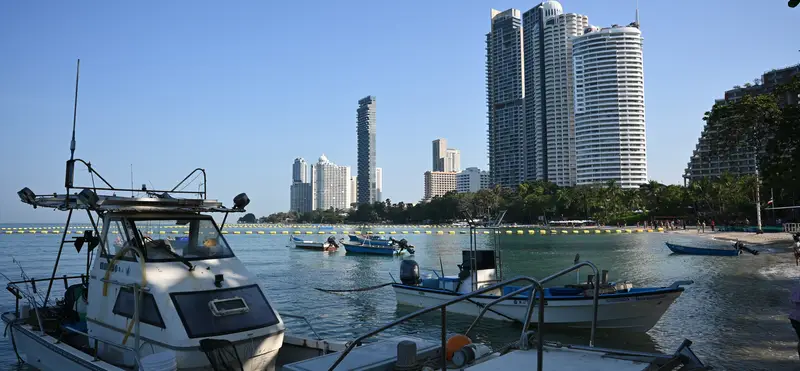
Thailand remains one of Southeast Asia's most accessible condominium markets for international buyers, but the comparison is becoming more demanding. Legal access, delivery record, building management, total ownership costs and resale prospects now matter at least as much as the headline price.
Foreign buyers took ownership of 3,241 condominium units in Thailand in the first quarter of 2026, according to the country's Real Estate Information Center. That was 17.3 per cent fewer than a year earlier. The value of the transfers fell by 17.9 per cent to THB 13.46 billion.
The figures cover only one quarter, and the national total conceals major differences between buyer groups. Transfers to Chinese buyers fell by 38.8 per cent year on year, while transfers to Russian buyers rose by 33.0 per cent. "Foreign demand" is not a single trend.
The contrast is especially relevant to Pattaya. In the wider Eastern Economic Corridor, 10,644 homes changed hands in the first quarter, up 11.6 per cent year on year. Condominiums accounted for 3,210 transfers, of which 2,959 were in Chonburi, home to Pattaya. The Chonburi total includes Thai and foreign buyers, but it confirms substantial local activity while foreign purchases weakened nationally.
Key Takeaway: Demand is still there, but a competitive price and a tropical location are no longer enough on their own to win an overseas buyer.
The Cheapest Square Metre Can Be the Wrong Comparison
Price per square metre is easy to advertise and easy to compare. It is also incomplete.
For an overseas buyer, the real comparison starts after the asking price. A cheap unit can lose its appeal quickly if the foreign quota is gone, the building is poorly run, completion slips or resale demand is weak. A more useful regional comparison is therefore based on usable ownership: how clearly a buyer can acquire, operate and eventually sell the property.
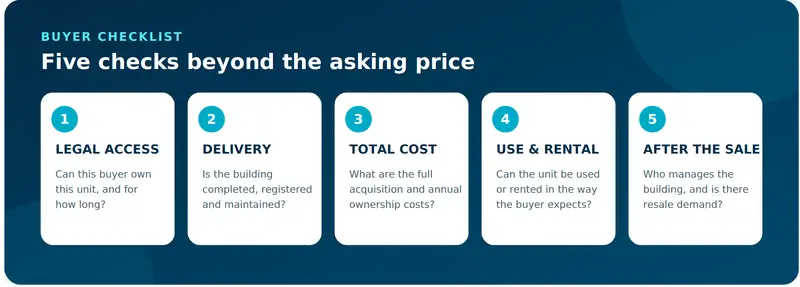
Buyer Checklist: Five Checks Beyond the Asking Price
- Legal Access: Can this buyer own this unit, and for how long?
- Delivery: Is the building completed, registered and maintained?
- Total Cost: What are the full acquisition and annual ownership costs?
- Use & Rental: Can the unit be used or rented in the way the buyer expects?
- After the Sale: Who manages the building, and is there resale demand?
The result is not a league table. It is a way to see why two apartments with similar prices can carry very different risks even in neighbouring buildings.
Thailand: An Established Route, with Project-Level Limits
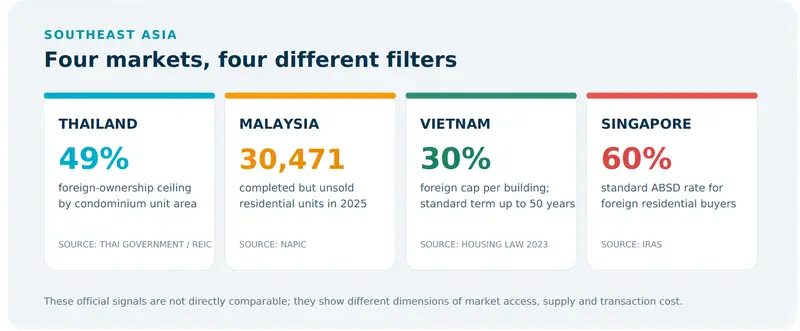
Thailand offers an established route to foreign condominium ownership. Government guidance states that foreign ownership cannot exceed 49 per cent of a condominium’s total unit area and notes that purchase funds require transfer from abroad with banking evidence.
The remaining quota must still be confirmed for the specific building. Buyers must also distinguish the registered unit from contractual promises concerning furniture, rental management, facilities or future phases.
For completed developments, brochures matter less than what can be inspected: the condition of earlier buildings, maintenance charges, defect handling, reserve funding, and owner communication. A long delivery record counts only if the buildings themselves back it up.
Southeast Asia is Not One Condominium Market
The regional alternatives show why there is no single Southeast Asian condo market. Official data are not directly comparable, but the differences expose the questions a buyer needs to ask.
| Market | Current Signal from Official Sources | What It Illustrates | Important Caveat |
|---|---|---|---|
| Thailand | Foreign condominium transfers fell 17.3% YoY in Q1 2026; official foreign-ownership ceiling is 49% of total unit area. | An established foreign-ownership route, but greater dependence on project quality and a changing buyer mix. | National averages do not price a Pattaya unit; foreign quota must be checked building by building. |
| Malaysia | The 2025 official report recorded 30,471 completed but unsold residential units; condos/apartments represented 47.1%. | Abundant choice can give buyers negotiating power while raising questions about absorption and occupancy. | Serviced apartments are reported separately as commercial property; totals are not directly comparable with Thai condos. |
| Vietnam | Housing Law (Jan 2025) allows eligible foreign buyers to own up to 30% of apartments in a building; standard term up to 50 years. | Growth expectations must be assessed alongside project eligibility, ownership limits, and a renewed legal framework. | Legal access is project-specific and subject to defence, security and other statutory conditions. |
| Singapore | Standard Additional Buyer’s Stamp Duty (ABSD) for foreigners is 60%. In Q2 2026, 3,813 resales represented 62.0% of all sales. | Strong official data and a visible resale market provide a useful transparency benchmark. | The tax burden makes Singapore a benchmark rather than a direct price competitor for most overseas buyers. |
Malaysia Shows Why Supply Needs Context
Malaysia's National Property Information Centre recorded 30,471 completed but unsold residential units worth RM 17.73 billion in 2025, up 31.6 per cent by volume from 2024. Condominiums and apartments accounted for 14,357 units, or 47.1 per cent of that stock. The definition covers completed units that remained unsold for more than nine months after launch; it is not a count of distressed property or of homes aimed exclusively at foreigners.
Malaysia also classifies serviced apartments as commercial property. The report listed 18,752 completed but unsold serviced apartments and 50,329 unsold units under construction. Combining these categories with residential condominiums would create a false comparison with Thailand. The defensible conclusion is narrower: supply and classification can materially affect occupancy, management economics, and resale competition.
Vietnam Combines Access with a Newer Rulebook
Vietnam is often discussed through the language of growth. For a foreign condominium buyer, however, the legal structure is as important as the macroeconomic story.
Vietnam's Housing Law, effective from January 2025, permits eligible foreigners to acquire homes in defined commercial projects, subject to security restrictions and ownership caps. Foreign ownership is limited to 30 per cent of apartments in a condominium building. For an individual, the standard term is up to 50 years from certification, with one extension of up to 50 years possible.
For a buyer, the practical difference is clear. Before comparing prices, it is necessary to check whether the project is open to foreign ownership, whether quota remains, what the certificate covers and how the ownership term may affect resale. A low launch price tells you none of that.
Singapore is a Transparency Benchmark, Not a Direct Substitute
Singapore sits at the opposite end of the accessibility spectrum for many international buyers. The Inland Revenue Authority of Singapore lists a standard Additional Buyer's Stamp Duty rate of 60 per cent for foreigners buying residential property from 27 April 2023, although relief may apply in specific circumstances.
Singapore also publishes detailed information on prices, rents, sales, supply and vacancies. In the second quarter of 2026, 3,813 private residential resales accounted for 62.0 per cent of all sales, while non-landed prices edged down by 0.1 per cent from the preceding quarter. It therefore serves less as a direct price competitor to Pattaya than as a benchmark for verifiable transaction data and an observable secondary market.
The Next Competition is for Trust
The next phase of competition is likely to be less about launch-price headlines and more about proof. Buyers will still compare location, layout and price, but those are becoming entry-level requirements rather than the whole sales pitch.
- Inspectable completed projects
- Clear foreign-quota information
- Documented building management
- Itemised ownership costs
- Realistic rental assumptions
- Evidence of resales
The price paid at transfer is only the first number. Buyers also face taxes and fees, furnishing, maintenance, reserve contributions, management costs, periods without a tenant and, eventually, the time and cost of selling.
Thailand still has a strong case: foreign condominium ownership follows an established route, and the wider Chonburi data show real transaction activity around Pattaya. But neither point tells a buyer whether a particular building will be well managed or easy to resell. In a more selective market, that project-level evidence matters. The winners may not be the buildings with the lowest price per square metre. They will be the ones that make ownership clear before the sale — and can show, through completed projects, what happens afterwards.
Sources & Methodology
Methodology: Vision Finland reviewed official government, regulator and national property-information sources available by 14 August 2026. The indicators are intentionally presented as different market signals, not as a direct ranking. National definitions, property classifications and reporting periods vary. All analysis and conclusions are those of Vision Finland.
Scope: This article provides general business information and market analysis. It is not personalised legal, tax, financial or investment advice. Property rules, taxes and project eligibility can change; prospective buyers should obtain current independent professional advice before a transaction.
- Real Estate Information Center, Thailand. Foreign condominium transfers, Q1 2026.
- Real Estate Information Center, Thailand. Eastern Economic Corridor housing market, Q1 2026.
- Thailand Government. Foreign property ownership guidance.
- National Property Information Centre, Malaysia. Property Market Status Report 2025.
- Government of Vietnam. Housing Law No. 27/2023/QH15.
- Inland Revenue Authority of Singapore. Additional Buyer's Stamp Duty.
- Urban Redevelopment Authority, Singapore. Q2 2026 real-estate statistics.