

Saab Gripen E/F fighter jets soar over the iconic King and Queen Royal Pagodas in Doi Inthanon. (AI created)
How Sweden's Saab secured a strategic victory over US competitors, and what this means for Nordic companies in ASEAN
While Nordic business circles are increasingly tuning into the developments in Southeast Asia's growing markets, a significant milestone is worth noting. In August 2025, Thailand's cabinet officially approved the acquisition of four Swedish Saab Gripen E/F fighter jets, marking not just a defence procurement decision but a case study in how Nordic companies can successfully compete against global giants in the strategically vital ASEAN region.
The Deal: Strategic Investment in Air Superiority
Thailand's Royal Thai Air Force (RTAF) has committed to purchasing 12 Gripen E/F aircraft in a phased approach through 2034, with an initial procurement of four jets valued at approximately $600 million. While the initial volume may appear modest, this decision carries outsized strategic significance that extends far beyond the numbers.
This purchase builds upon Thailand's existing relationship with Swedish defence technology – the RTAF already operates 11 Gripen C/D fighters acquired in 2008, making Thailand the fourth nation globally to select the advanced Gripen E/F variant after Sweden, Brazil, and Colombia. More importantly, it establishes a crucial precedent in a region where fighter aircraft purchases reflect a broader push for military autonomy at a time of rising great power rivalry and supply chain concerns.
The urgency behind Thailand's decision becomes clear when considering the timeline: Thailand's ageing F-16 fleet, in service for over 37 years, faces decommissioning between 2028 and 2035. This creates a critical window for replacement that adds strategic importance to every procurement decision.
The approval's timing is significant as Thai Gripens saw their first combat deployment during border tensions with Cambodia in July 2025, proving their operational readiness. The July operation, alongside Thailand's F-16s, demonstrated the platform's capabilities and validated Thailand's investment in Swedish technology.
Historic Milestone: Thai Gripens made their combat debut in July 2025, successfully proving the platform's operational effectiveness in real-world conditions and validating Thailand's strategic investment.
Strategic Marketing: Beyond Traditional Defence Sales Channels
Saab's success in Thailand demonstrates how sophisticated market cultivation extends well beyond conventional government-to-government defence sales. The company's approach highlights the importance of building brand recognition and institutional relationships across multiple stakeholder groups, rather than focusing exclusively on defence ministry contacts.
A concrete example emerged in June 2024, when Saab was prominently featured in a Bangkok Post special supplement celebrating the Thai-Swedish Chamber of Commerce's 35th Anniversary and Swedish National Day. This strategic placement, alongside other major Swedish brands, positioned Saab as an integral part of the broader Thai-Swedish economic partnership rather than merely a defence contractor.
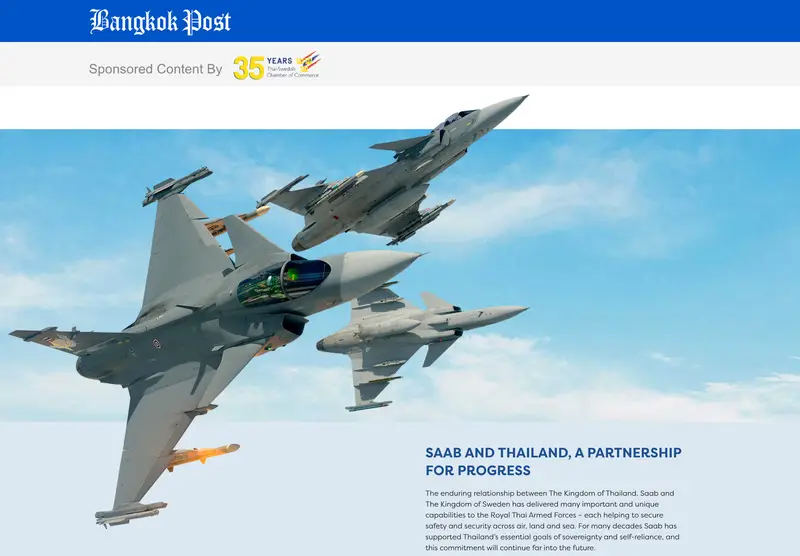
The Bangkok Post Thai-Swedish Chamber of Commerce (TSCC) Special Supplement (June 2024)
This multi-layered approach, combining sustained engagement through chambers of commerce, embassy networks, and high-visibility business media, creates competitive advantages that purely transactional approaches cannot replicate. For Nordic companies entering ASEAN markets, this demonstrates how leveraging established bilateral frameworks and local market knowledge enables precisely targeted strategies that build trust and credibility over time.
Why Sweden Won Over the US
Thailand's choice of the Gripen E/F over Lockheed Martin's F-16 Block 70/72 signals a strategic shift that Nordic companies should study. Saab's comprehensive market approach and Thailand's focus on operational autonomy were key factors. Recent tensions along the Thai-Cambodian border have influenced Thailand's defence modernisation priorities.
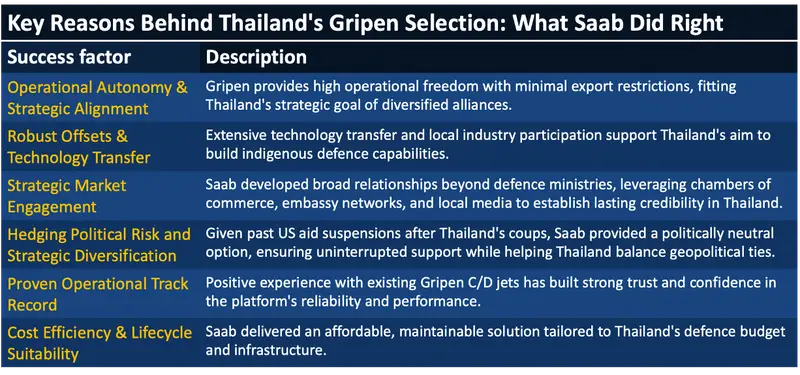
Lessons for Nordic Companies
Thailand's Gripen selection offers valuable insights not just for Finnish and other Nordic defence manufacturers, but for all companies eyeing ASEAN markets.
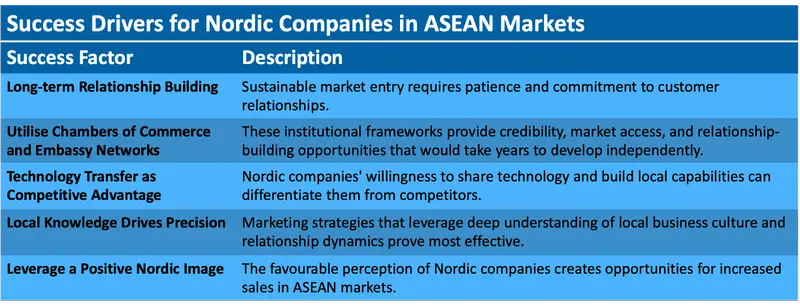
The Broader ASEAN Opportunity
Thailand's decision reflects a trend among ASEAN nations to increase defence spending due to regional security challenges, creating a market worth billions. Notably, Singapore plans to acquire eight F-35B fighter jets from Lockheed Martin to replace its old F-16s. Indonesia has announced plans to procure F-15EX fighters, shifting focus from Chinese J-10 jets and European options. Malaysia and Vietnam are also exploring fighter replacement programs, offering opportunities for various suppliers.
The significance extends beyond fighter jets to broader defence capabilities where Nordic companies excel. Finland's Patria , with its AMV armoured vehicles and 2023 partnership with Lockheed Martin's F-35 consortium, represents precisely the type of specialised, high-tech defence capability that ASEAN nations increasingly seek. The company's €825.7 million revenue in 2024 and expansion into global supply chains positions it well for Southeast Asian opportunities.
Thailand's validation of Nordic defence capabilities could prove instrumental for Nordic companies seeking market entry. The region's emphasis on technology transfer, operational independence, and diversified supply chains aligns perfectly with Nordic business models that prioritise long-term partnerships over transactional relationships.
ASEAN Defence Market Opportunity: ASEAN's defence spending is projected to exceed $50 billion annually by 2030 as countries modernise across various sectors. Beyond fighter purchases, there are significant opportunities for Nordic companies in armoured vehicles, surveillance, cybersecurity, unmanned systems, and defence innovation. Nordic expertise in technology transfer and sustainable partnerships aligns well with ASEAN's strategic needs.
Strategic Implications for Nordic-ASEAN Relations
The Thai-Swedish defence partnership exemplifies potential Nordic-ASEAN strategic cooperation, moving beyond mere transactions to enhance defence relationships. Thailand's use of Swedish technology sends a strong message to neighbouring nations, showcasing a model for regional procurement. This collaboration also encompasses Nordic expertise in clean technology and digitalisation, which aligns with ASEAN development goals. The trust built through these defence partnerships can lead to broader commercial ties.
During the 2025 Shangri-La Dialogue, Finnish Minister of Defence Antti Häkkänen emphasised the importance of connecting European and Indo-Pacific security. He noted Finland's commitment to fostering Nordic partnerships that support defence collaboration in Southeast Asia. Finland also leads advanced innovation through the EU's quantum defence project, QUEST, coordinated with Finland's VTT Technical Research Centre.
Looking Forward
Thailand's Gripen acquisition sets a precedent that other Nordic companies would be wise to study and emulate. The success factors include long-term commitment, technology sharing, operational flexibility, and respect for customer autonomy, providing a roadmap for Nordic businesses seeking to compete effectively in Southeast Asia's dynamic markets.
Thailand's choice of Swedish fighters over American alternatives signals a shifting landscape where smaller, technology-focused nations can successfully compete against global superpowers. The key lies in understanding that success in Southeast Asia isn't just about having the best product; it's about building the best partnerships.
As Vision Finland continues to track Nordic-ASEAN developments, Thailand's Gripen story stands as a compelling example of how strategic patience, technological excellence, and respect for customer priorities can create lasting business success in one of the world's most dynamic regions.
What opportunities do you see for Nordic companies in Southeast Asia's defence and technology sectors? Share your thoughts on how other industries can learn from Sweden's approach in Thailand.
Written by Antti Rahikainen.
Sources
- The Eurasian Times - "Thailand's Gripen Fighter Jets See Combat For The First Time In Nearly 4 Decades"
- Defense News - "Thailand approves purchase of four Gripen fighter jets"
- Bangkok Post - "Cabinet approves Gripen fighter jet purchase"
- FlightGlobal - "Thailand cabinet approves Gripen E/F acquisition"
- The War Zone - "Thailand's Gripens See Their First Combat Action Against Cambodia"
- Jane's Defence Weekly - "Thailand confirms Gripen E purchase decision"
- Bangkok Post - "Thai-Swedish Chamber of Commerce 35th Anniversary Special Supplement" (June 2024)
- Defense & Security Monitor - "Thailand border tensions drive fighter procurement"